
Japanese Beetles: The Buttholes Are Back
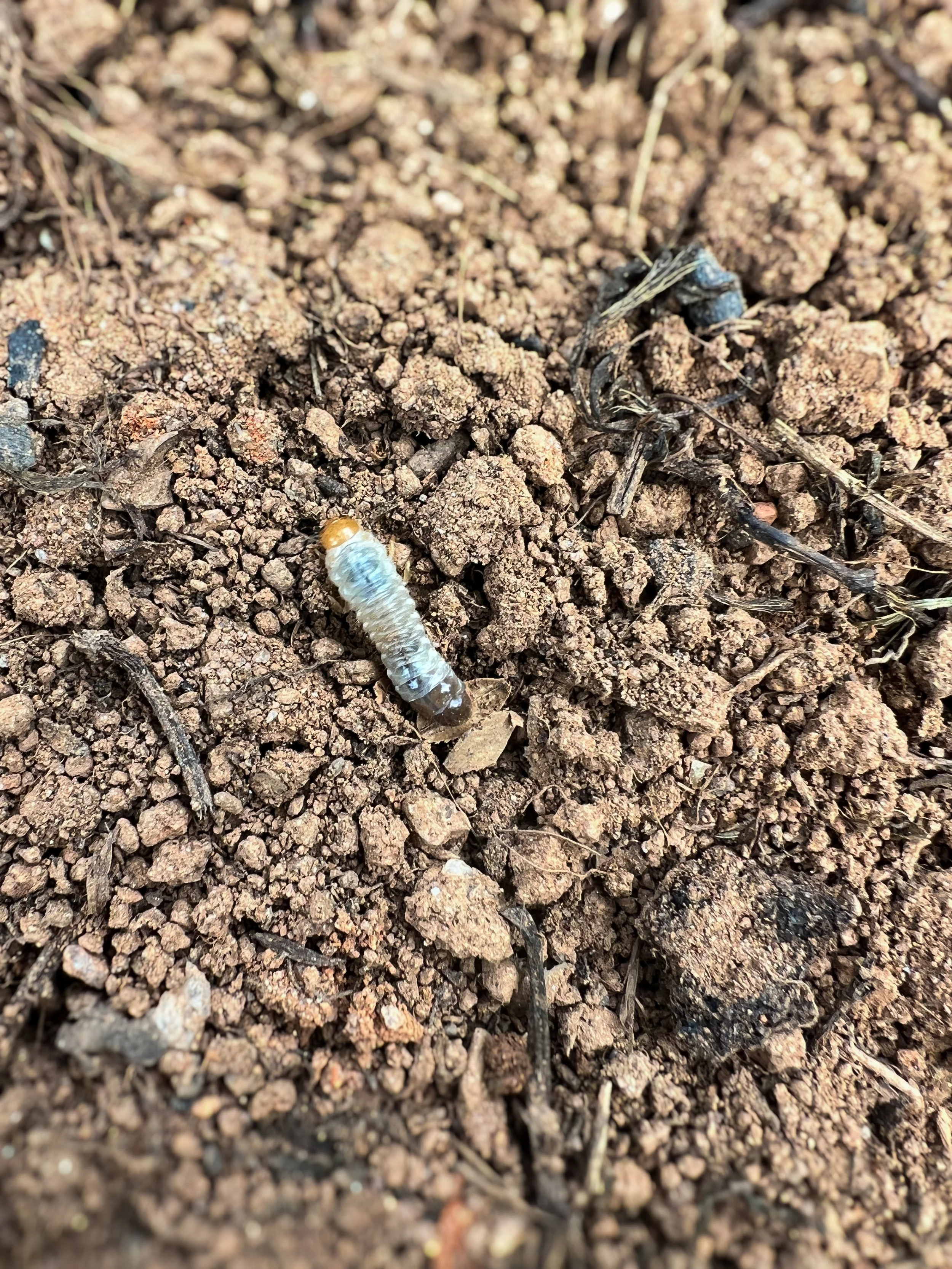
Japanese Beetle Larvae
This last Saturday, I planted several rows of perennials, and guess what I found buried in the soil? Yep. So many Japanese Beetle larvae that it was actually disturbing. This is what a Japanese Beetle larva looks like, with its milky white body and unmistakable tan or orangeish-brown head. I’d really like to cuss right now, but suffice it to say, they are buttholes.
Let me back up a bit so you can get the full picture of why this is so menacing.
This last June and July were, by far, the worst season I’ve ever experienced with Japanese Beetles. There were soooooo many. A lot of it had to do with their hatching just days before I went on vacation and left the farm for eight days, so most of their initial damage was done before I could get a handle on it. But the beetles continued on for another month and truly wreaked havoc.
Here is the bigger problem: Females lay around 40 to 60 eggs each, depositing them a few inches deep in moist soil. So for every one female beetle that escaped my clutches, she potentially left 40 to 60 eggs in my yard for me to contend with at a later date.
After the eggs are laid, they generally hatch in 10 to 14 days. During this larval stage, they feed on plant and grass roots. Have you ever noticed an area of turf that turns brown and dies in patches, especially in the fall? It’s very likely Japanese Beetle grubs feeding on those tender grass roots. This stage lasts until late spring, when they become pupae and eventually emerge as adults.
Then all heck breaks loose.
Several flower beds had become overgrown with grass and weeds during the late spring and early summer. After the beetle fiasco, I moved on with my life and laid out black landscape fabric for a couple of months to kill the weeds and grass in preparation for late-summer and fall plantings.
It worked like a charm. But when I took the fabric off this weekend to plant yarrow, sedum, rudbeckia, and echinacea, I swear, every hole I dug had a larva in it.
This tells me I’m going to be overrun with them again next summer because this was only one 4-by-20-foot row. What about the other rows already planted and the acre or more of grass?
Ugh.
Again… buttholes is the nicest thing I can say about them.
And for those of you who are in the “they only last a month or two” camp, consider this: If 500 female beetles showed up in 2026, and each laid an average of 50 eggs, with half surviving to adulthood, that’s 12,500 beetles potentially showing up in 2027. Now do the same math again. If those 12,500 beetles were female, each laid 50 eggs, and half survived, you’d be looking at 312,500 beetles in 2028.
Obviously, nature doesn’t work quite that neatly, but you get my point. Leaving them alone doesn’t exactly make the problem go away.
A very popular flower farming duo discussed the dreaded Japanese Beetles on a podcast. They stated unequivocally that the beetles do not eat the flowers themselves—just the leaves—and they are most definitely in the “they only last a month or two, so leave them alone and don’t waste your time” camp.
With the utmost love and respect, I beg to differ. My Japanese Beetles dine on every petal they find. Maybe my beetles are special, but what they feast on for the month or two they are here is devastating for my small farm—or at least it was in 2026. So I most definitely will not be taking their advice and more or less ignoring them. I will battle back.
So how do we battle back and combat these total garden wreckers?
Well, we can start by treating the soil.
In the past, I have used beneficial nematodes, and I can assure you that I am doubling down on them again this year. I’ve gotten lax in the last year or two, and I think perhaps that has been part of the problem.
I like Triple Threat Beneficial Nematodes—Sf, Sc, Hb (H. bacteriophora, S. carpocapsae, and S. feltiae)—sold by Arbico Organics. There are also different brands of grub control available, like Spectracide Grub Control. Another product called Milky Spore is a natural biological control that uses the bacterium Paenibacillus popilliae to target Japanese Beetle grubs in the soil.
Once the adults make their presence known, I have had great luck with beetle traps—if put out early enough, which I did not do this year. I know they are controversial, and some say they attract more beetles to your garden. But if it attracts them straight to the trap, then what is the problem? In my experience, they work best within six feet of the flower beds and should be put out at the first sign of the beetles rather than halfway through their season.
Needless to say, I’ll be focusing on controlling the larval stage of this hideous scourge on society so the adults won’t eat me out of house and home again next year.
Because apparently this last June and July, my Japanese Beetles were busy making plans for the future.
Judging by what I found in that single 4-by-20-foot row, they’ve been very productive.
Wish me luck.